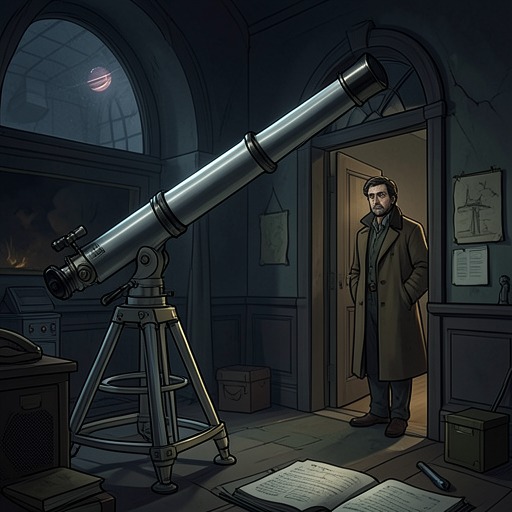
Brattleboro
The Colour Out of SpaceBrattleboro is the threshold through which Albert N. Wilmarth enters the Vermont hills and the practical hub around which crucial communications about Henry Wentworth Akeley pass. Its railway station brings Wilmarth to his first meeting with Noyes, while its postal and express connections carry the phonograph record and the black stone into the story’s widening crisis. After fleeing Akeley’s farmhouse, Wilmarth returns to Brattleboro to investigate what happened, then resolves not to go back to Vermont.
Setting and Route into Vermont
Brattleboro first appears as the destination at the end of Wilmarth’s northbound journey. After changing trains at Greenfield, he travels through a landscape that he regards as older and less modern than the urban and industrial regions where he has spent his life. The route follows the Connecticut River; after crossing it, the train passes the steep slope of Wantastiquet on the New Hampshire side. Wilmarth then reaches the long train shed at Brattleboro station and steps into the Vermont setting he had previously known only through reports and reading.
The station serves as more than a geographical marker. It is where Wilmarth expects to meet Akeley, whose letters have drawn him into the investigation, and where the expected host is replaced by a stranger. Brattleboro therefore marks the transition from an exchange of claims and physical evidence at a distance to Wilmarth’s direct involvement in the countryside Akeley has described.
Akeley’s Communications and Evidence
Brattleboro repeatedly figures as a safer or more useful point of exchange than the isolated roads and railway branch farther north. Toward the end of June, Akeley sends the phonograph record from Brattleboro because he does not trust conditions on the branch line. He has driven there in his Ford, though he has become afraid of travelling the lonely Vermont roads and will go into Townshend for supplies only in daylight. The town is thus linked to the circulation of the recording even as Akeley’s increasing caution makes the journey to it seem hazardous.
The record’s significance lies partly in the distance between the event it preserves and the route by which it reaches Wilmarth. Akeley says that he made it near a cave on the wooded western slope of Dark Mountain, at about one in the morning on May-Eve in 1915. The remote, muffled recording captures only fragments of a ritual-like conversation: one voice sounds human, while another has the buzzing quality Akeley associates with the Outside Beings. The recording reaches Wilmarth through Brattleboro, carrying the unexplained sound from a secluded hillside into an academic and domestic world where it can be replayed and reconsidered.
As letters go astray and Akeley grows more anxious about surveillance, he instructs Wilmarth to address further mail to General Delivery in Brattleboro rather than to Townshend. He plans to make frequent trips there by car or motor coach, the latter having recently replaced passenger service on the failing branch railway. This redirected correspondence gives the town a continuing role in their relationship: it is the designated point at which Akeley can still be reached, even as the loss of letters makes communication itself uncertain.
The Missing Stone and Wilmarth’s Arrival
Brattleboro is also connected to the failed shipment of the black stone. Akeley telegraphs Wilmarth that he is sending it by railway express from Bellows Falls on a train bound for Boston, from which Wilmarth expects it to reach Arkham. When the parcel does not arrive, Wilmarth contacts the express office and then the Boston North Station. The train was only thirty-five minutes late, yet no box addressed to him was aboard. The investigation into the missing shipment leads to a railway clerk’s recollection of an argument at Keene with a lean, sandy, rustic-looking man of a curious voice. The route through the region becomes part of the evidence: the stone vanishes in transit, and the reported encounter suggests a human intervention without resolving what happened to the object.
When Wilmarth finally arrives at Brattleboro station, he looks among the waiting cars for Akeley’s Ford. Instead, a younger, fashionably dressed man approaches and asks whether he is Albert N. Wilmarth of Arkham. Introducing himself as Noyes, the stranger says that he is a friend of Akeley’s and has come from Townshend in his place because Akeley has suffered an asthmatic attack. Noyes presents the illness as not serious and insists that the visit can proceed. His cultivated voice seems vaguely familiar to Wilmarth, though Wilmarth cannot place it; Noyes also does not resemble the bearded man in Akeley’s photograph.
The substitution is made tangible by the car Noyes offers: not the small, old vehicle Wilmarth expects from Akeley’s descriptions, but a large, immaculate recent model bearing Massachusetts plates. Wilmarth concludes that Noyes may be a summer visitor to the Townshend region, but the stranger’s confident reception and unexplained familiarity leave the meeting unsettled. Brattleboro is the scene of this first direct discrepancy between the person Wilmarth expects and the person who takes charge of bringing him onward.
Inquiry, Departure, and Narrative Role
After his escape from the farmhouse, Wilmarth remains in Brattleboro for a week and makes inquiries among people who knew Akeley. He finds that Akeley’s purchases of dogs, ammunition, and chemicals, as well as the cutting of his telephone wires, can be confirmed. People who knew him, including his son in California, acknowledge that his occasional references to strange studies had been consistent. These details do not settle the truth of Akeley’s claims, but they give Wilmarth grounds for rejecting the idea that the entire episode was simply a dream or delusion.
The accounts Wilmarth collects divide along social lines. Respectable townspeople call Akeley mad and treat the reported evidence as a deliberate or eccentric hoax. Country people, by contrast, support his statements: some had seen his photographs and black stone or heard the phonograph record, and they connect its buzzing voice and the strange prints with inherited local legends. Wilmarth also hears that suspicious sights and sounds increased around Akeley’s house after the discovery of the stone, and that the farmhouse is now avoided except by the mail carrier and other people willing to make the journey. The town’s inquiries thus extend the story beyond Wilmarth’s private encounter, while preserving a conflict between competing interpretations rather than producing a universally accepted explanation.
Wilmarth leaves Brattleboro resolved never to return to Vermont. The town’s narrative function is consequently double: it is the accessible point from which the evidence can be sent, received, and investigated, but also the last place from which Wilmarth can withdraw from the hills. The record, the lost stone, the redirected letters, and his arrival under Noyes’s guidance all pass through or depend on Brattleboro’s connections. Yet those channels do not dispel uncertainty; they carry it onward, making the town a boundary between ordinary systems of travel and communication and the unexplained events taking place beyond it.